University Grade Calculator
The free uni grade calculator for UK students. Enter your module grades and credits to calculate your degree classification instantly, whether you are tracking a First, 2:1, 2:2, or Third.
| Module Name | Grade (%) | Credits | |
|---|---|---|---|

How to Use the UK University Grade Calculator
Using this university grade calculator is straightforward. Follow these steps to calculate your degree classification accurately:
- Enter your module name in the first column. This is optional but helps you keep track of which grades belong to which modules.
- Enter your grade as a percentage in the Grade column. If your university uses letter grades, convert them to percentages first (e.g., an A might be 75%).
- Set the credit value for each module. Most UK modules are worth 20 credits, but dissertations and double modules are often 40 or 60 credits.
- Add more modules by clicking the "Add Module" button. You can add as many as you need.
- View your result at the top of the calculator. It shows your credit-weighted average and corresponding degree classification.
The calculator updates in real time as you enter grades, so you can experiment with different scenarios to see how each module affects your overall classification. If you want to break down individual modules into their assessment components first, use our module grade calculator.
Understanding UK Degree Classifications
The UK higher education system uses a classification system for undergraduate degrees that has been in place for over a century. Your degree classification appears on your certificate and transcript, and it is one of the first things employers look at when reviewing job applications.
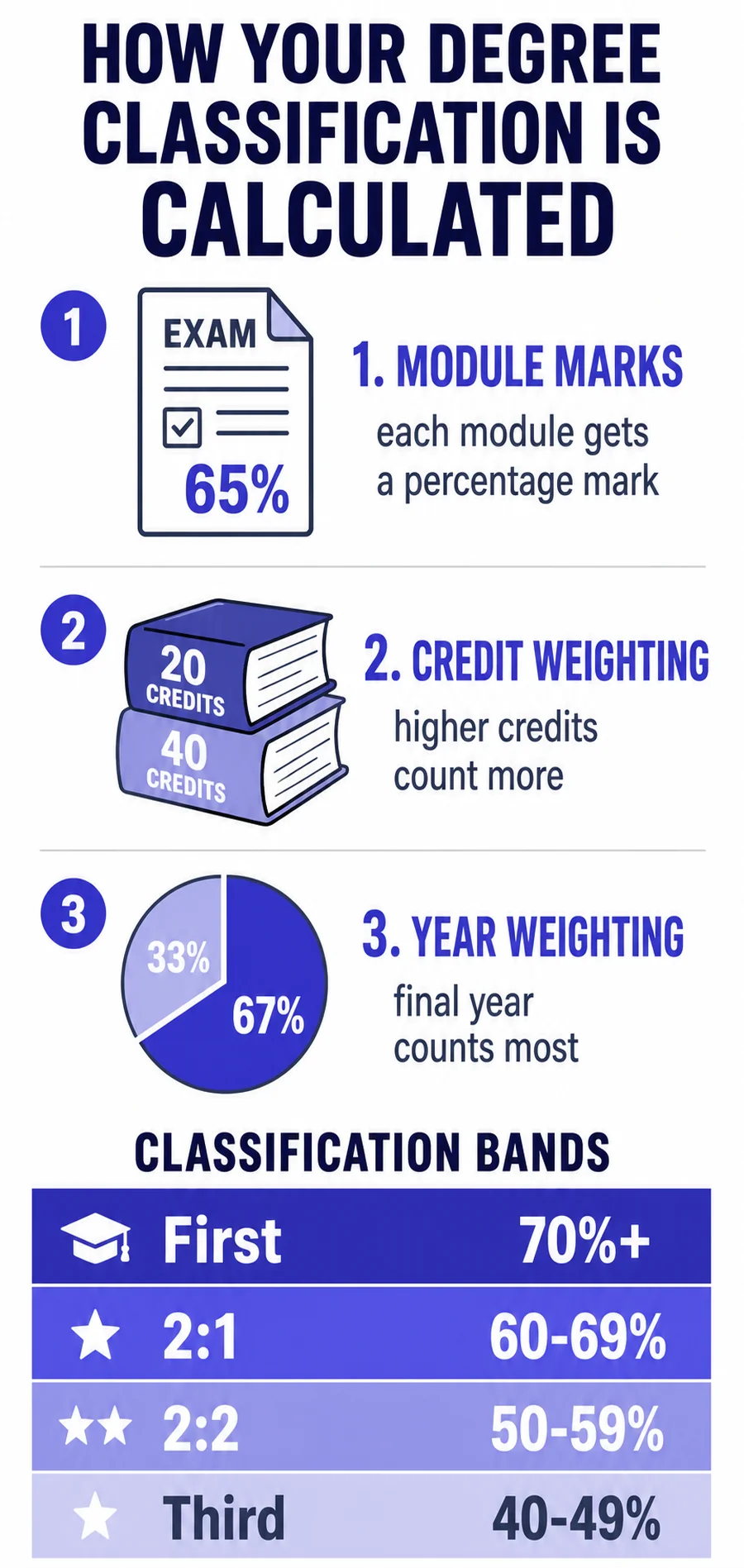
Degree classifications are based on your overall percentage average, which is calculated as a credit-weighted mean of your module marks. Here are the standard boundaries used by most UK universities:
UK Degree Classification Boundaries
| Classification | Percentage Range |
|---|---|
| First Class Honours (1st) | 70% and above |
| Upper Second Class (2:1) | 60% - 69% |
| Lower Second Class (2:2) | 50% - 59% |
| Third Class (3rd) | 40% - 49% |
| Fail | Below 40% |
First Class Honours (1st) - 70% and Above
A First is the highest undergraduate degree classification in the UK. It demonstrates exceptional academic achievement and a deep understanding of your subject. In 2022/23, HESA reported that 30% of classified first-degree qualifiers were awarded a First. A First is highly valued by employers, particularly for competitive graduate schemes, and is typically required for academic research positions and PhD applications. For a complete breakdown of what each classification means and how employers view them, read our guide on UK degree classifications explained.
Upper Second Class Honours (2:1) - 60% to 69%
A 2:1 (pronounced "two-one") is the most common degree classification in the UK: HESA reported 48% of classified first-degree qualifiers at this level in 2022/23. It is generally considered the minimum requirement for many competitive graduate jobs, management training programmes, and postgraduate study. Requirements vary by employer and course.
Lower Second Class Honours (2:2) - 50% to 59%
A 2:2 (pronounced "two-two") was awarded to 20% of classified first-degree qualifiers in 2022/23, according to HESA. While some graduate schemes require a 2:1, many employers accept a 2:2, particularly in sectors where practical experience is valued over academic grades. A 2:2 still represents a solid academic achievement and opens doors to a wide range of career paths.
Third Class Honours (3rd) - 40% to 49%
A Third is the lowest honours degree classification. While it may limit some graduate scheme applications, it is still a valid degree. Many successful professionals started with a Third and built their careers through experience, further qualifications, and demonstrable skills.
How Degree Classification Is Calculated
Your degree classification depends on a credit-weighted average of your module marks. For a detailed walkthrough with more examples, see our guide to calculating weighted averages. Here is the formula most UK universities use:
Overall Average = (Sum of each Module Grade x Module Credits) / Total Credits
For example, if you have three modules:
- Research Methods: 72% (20 credits) = 72 x 20 = 1,440
- Dissertation: 68% (40 credits) = 68 x 40 = 2,720
- Advanced Theory: 65% (20 credits) = 65 x 20 = 1,300
Total weighted marks: 1,440 + 2,720 + 1,300 = 5,460
Total credits: 20 + 40 + 20 = 80
Overall average: 5,460 / 80 = 68.25% = Upper Second Class (2:1)
Notice how the 40-credit dissertation has twice the influence of a 20-credit module. This is why credit weighting matters and why a simple average of your grades would not give an accurate classification. Our weighted grade calculator handles these calculations automatically.
Year Weightings in UK Universities
Most UK universities do not weight all years equally when calculating your final degree classification. The most common approach is to give greater weight to your final year, because it represents your most recent and advanced work. Common weighting patterns include:
| Weighting Pattern | Year 1 | Year 2 | Year 3 |
|---|---|---|---|
| Most Common | 0% | 33% | 67% |
| Alternative A | 0% | 40% | 60% |
| Alternative B | 0% | 25% | 75% |
| Equal Weighting | 0% | 50% | 50% |
Year 1 typically does not count towards your final classification, but you usually need to pass all first-year modules to progress to Year 2. Always check your university's specific regulations, as policies vary between institutions and even between departments within the same university. Our university pages, including Manchester Metropolitan University, University of Leeds, Open University, and University of St Andrews, provide provisional examples and should be checked against your current programme regulations.
Tips for Improving Your Degree Classification
If you are aiming for a higher classification, here are evidence-based strategies that can help:
- Focus on high-credit modules. A dissertation worth 40 credits has double the impact of a standard 20-credit module. Invest proportionally more time in higher-credit work.
- Use the target grade feature. Enter your completed grades into the calculator and use the target feature to see exactly what you need on remaining modules. You can also use our dedicated final grade calculator for detailed target planning.
- Understand marking criteria. Read your module handbooks carefully. Knowing the difference between a 2:1 and a First in your marker's eyes helps you target your effort.
- Attend feedback sessions. Module feedback from previous assessments is the most underused resource in higher education. It tells you exactly where you lost marks and how to recover them.
- Plan your module choices strategically. If you have elective choices, consider modules where the assessment style suits your strengths (e.g., coursework-heavy vs exam-heavy).
Common Mistakes When Calculating Grades
Students frequently make these errors when trying to work out their degree classification manually:
- Ignoring credit weighting. A simple average of your grades is not the same as a credit-weighted average. A 40-credit module counts twice as much as a 20-credit one.
- Including Year 1 grades. At most universities, first-year marks do not count towards your classification. Check whether yours is an exception.
- Forgetting year weightings. If your university weights Year 3 at 67%, your final-year performance is twice as important as Year 2.
- Using the wrong scale. Some modules are marked on different scales (e.g., pass/fail, letter grades). Use our percentage grade calculator to convert everything to the same scale before calculating.
- Not accounting for capped marks. If you had a module mark capped due to a resit or late submission, use the capped mark, not the original mark.
Borderline Cases and University Policies
If your average falls close to a classification boundary (for example, 68-69% near the First/2:1 border), many universities have borderline policies that may upgrade your classification. Common approaches include:
- Module profile method: If a certain percentage (often 50% or more) of your final-year credits fall in the higher classification band, you may be upgraded.
- Preponderance calculation: The university looks at how many credits you scored in each classification band and awards the one where you have the most.
- Viva voce: In rare cases, borderline students may be invited for an oral examination to determine their final classification.
- Discretionary upgrade: Some exam boards have the authority to upgrade borderline candidates based on trajectory, extenuating circumstances, or overall performance profile.
These policies vary significantly between institutions, so if you are near a boundary, check your university's academic regulations or speak with your personal tutor. Our degree classification calculator explains these borderline policies in more detail.
Uni Grade Boundaries: Quick Reference
Uni grade boundaries determine which classification band your overall percentage falls into. These boundaries are standardised across most UK universities, making it straightforward to check where you stand:
| Classification | Grade Boundary | Borderline policy |
|---|---|---|
| First Class (1st) | 70.00% and above | Check your programme regulations |
| Upper Second (2:1) | 60.00% - 69.99% | Check your programme regulations |
| Lower Second (2:2) | 50.00% - 59.99% | Check your programme regulations |
| Third Class (3rd) | 40.00% - 49.99% | Check your programme regulations |
| Fail | Below 40.00% | N/A |
Borderline and rounding rules are not universal. Your university's exam board applies the policy in your programme regulations, which may use a module profile, a second calculation, or no upgrade route at all.
How This Grade Calculator Compares
This is not just a basic grade calculator or simple UG calculator. Unlike simple tools that only output a number, this uni grade calculator provides a full breakdown with classification display, visual progress tracking, and a target grade planner. The grade calculator works for all UK universities and supports any combination of credit values.
Students at specific universities can use our tailored calculator pages as a starting point for entering module marks and credits. The assumptions shown on each page are provisional: confirm the weighting, rounding and classification rules in your current programme regulations before relying on an estimate.
Specialist Grade Calculators
Beyond the standard undergraduate grade calculator, we offer tools for every qualification type. BTEC students can use the BTEC grade calculator with Distinction*, Distinction, Merit, and Pass boundaries. Postgraduate students can calculate their masters classification with the masters grade calculator. For international applications, the GPA calculator converts UK percentages to the 4.0 GPA scale.
For a deep understanding of how the entire UK grading system works, from assessment types to external examiners, read our comprehensive guide on how university grading works in the UK.
UK Uni Grade Calculator: From Marks to an Overall Result
Use this university grade calculator to turn confirmed module marks and credits into a provisional degree average. Start with the grades that your course says count, use each module's actual credit value, and check your final course regulations before treating the result as official.
If you only have raw assessment marks, first use the percentage grade calculator or module grade calculator. If you already have an average and need a required mark, use the final grade calculator instead of trying to estimate it manually.
Frequently Asked Questions
Related Calculators
Module Grade Calculator
Calculate individual module grades with multiple assessments and custom weightings.
Weighted Grade Calculator
Work out credit-weighted averages from module grades and credits.
BTEC Grade Calculator
Calculate BTEC grades including Distinction*, Distinction, Merit, and Pass.
Masters Grade Calculator
Calculate postgraduate grades with Distinction, Merit, and Pass boundaries.
Final Grade Calculator
Find out what you need on your final exams to reach your target grade.
GPA Calculator UK
Convert UK percentage grades to GPA scale for international applications.
Degree Classification Calculator
Check which classification band your percentage average falls into.
Percentage Grade Calculator
Convert raw marks to percentages and calculate overall percentage.
About This Calculator
This free UK university grade calculator was built for students who want a fast, accurate, and ad-light way to check their degree classification. Unlike other grade calculators that are cluttered with ads or require registration, this tool is completely free, works instantly in your browser, and does not store any of your data.
Whether you are a first-year student planning ahead, a second-year trying to work out what you need for a 2:1, or a finalist checking whether a First is within reach, this calculator gives you a provisional credit-weighted result in seconds. Use our module grade calculator for individual module breakdowns, or the weighted grade calculator to calculate a credit-weighted average before applying your programme's published year weighting.